
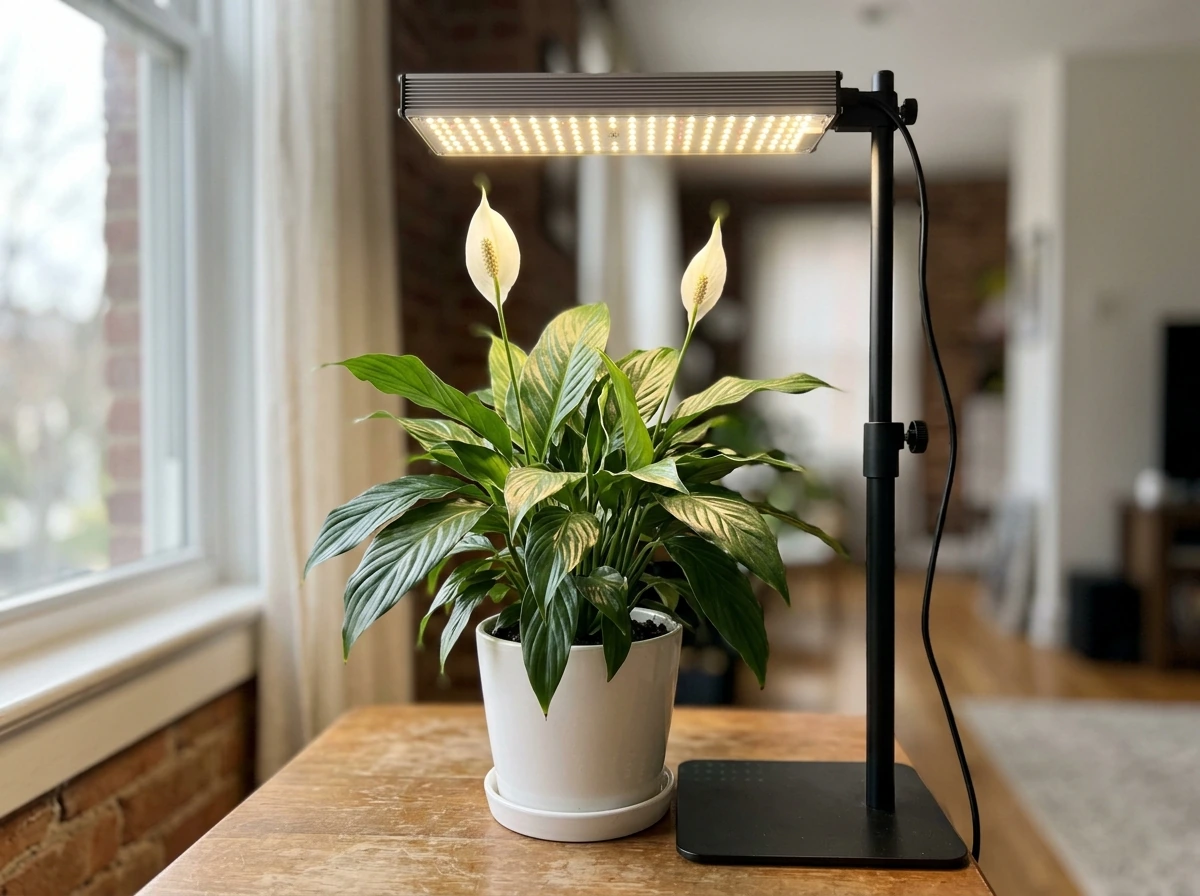
Yes, peace lilies can absolutely grow under grow lights, and honestly, they're one of the easier houseplants to get right with artificial light. Because they're naturally adapted to life under a forest canopy where light is filtered and dim, they don't need a powerful setup to thrive. A modest LED grow light on a timer can keep your peace lily healthy, green, and even blooming when window light just isn't cutting it.
Do Peace Lilies Like Grow Lights? Setup Guide Indoors
Marcus Hendricks
24 Mar 2026
How peace lilies respond to artificial light
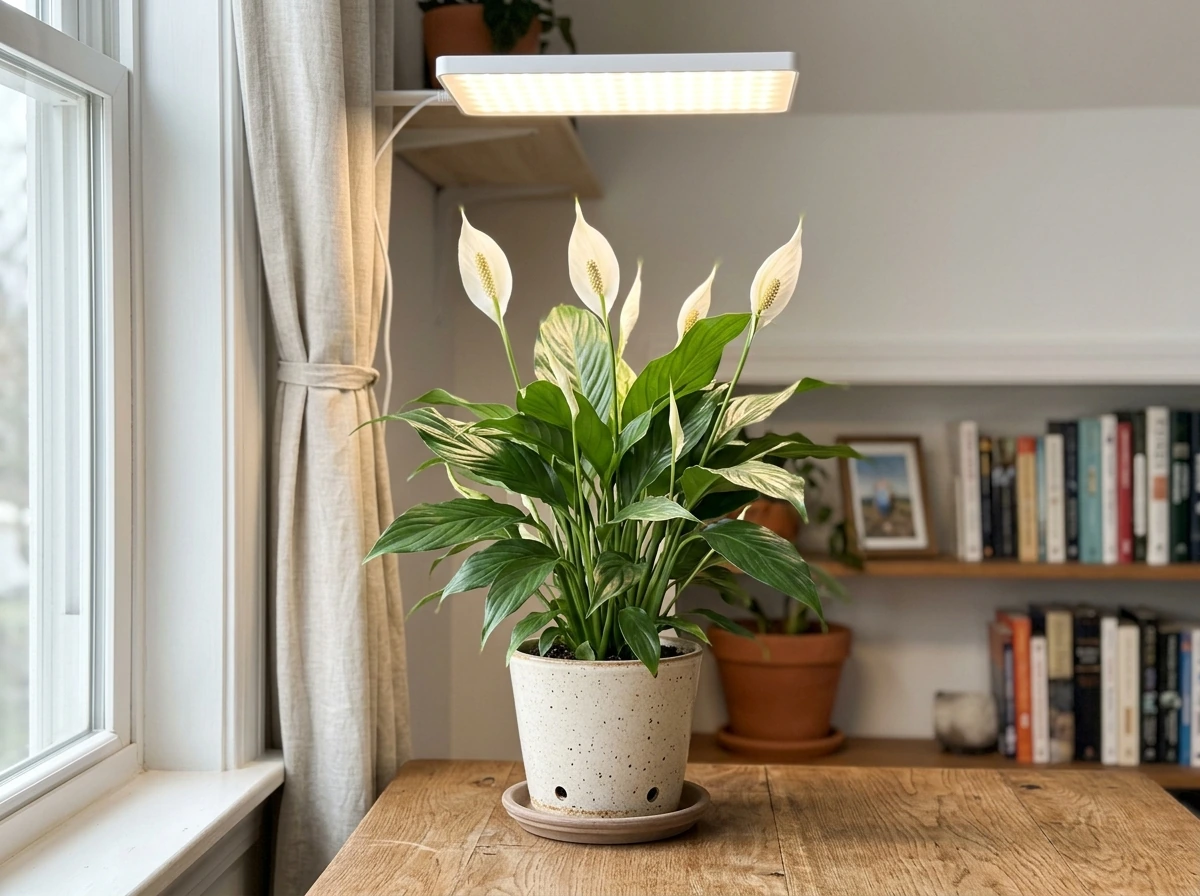
Peace lilies (Spathiphyllum) evolved under dense tropical canopy, which means dappled, indirect light is their happy place. That's actually good news for grow light setups, because you're not trying to replicate full sun. Natural window light and artificial light hit the plant the same way biologically, as long as the intensity and duration are right. The plant doesn't know or care whether photons came from the sun or an LED panel.
What does matter is consistency. A peace lily under a grow light on a reliable timer will often outperform one sitting in an unpredictable north-facing window that gets deep shade in winter. University of Maryland Extension places peace lily firmly in the low-light category, citing a range of 25 to 100 foot-candles. can peace lily grow in low light That's a very achievable target with even a basic grow light, especially when natural light is weak, seasonal, or simply not available in the room you're working with.
Research on Spathiphyllum shows it acclimates well across a range of light intensities without suffering photoinhibition, which means the plant can adjust when you tune your setup over time. It's forgiving, not fragile. That said, "low light tolerant" doesn't mean "no light." Even if can peace lily grow without sunlight, you'll still need to keep the light intensity and duration adequate to avoid losing blooms and seeing the plant decline. If the intensity drops too low for too long, you'll lose blooms and eventually see the plant decline. Getting the numbers dialed in matters.
Minimum and ideal light levels for grow lights
Let's talk numbers, because "low light" is one of the most misused phrases in houseplant care. For grow lights, there are two useful units to know: foot-candles (fc), which measure how bright a light appears, and PPFD (micromoles per square meter per second, or μmol/m²/s), which measures the actual light energy available for photosynthesis. They're related but not identical.
For practical peace lily care, here's what the numbers look like across the range from survival to flowering:
| Growth Stage / Goal | Foot-Candles (fc) | Approximate PPFD (μmol/m²/s) | What to Expect |
|---|---|---|---|
| Bare minimum survival | 25–50 fc | ~5–10 μmol/m²/s | Plant stays alive but grows very slowly; no blooms |
| Healthy vegetative growth | 50–200 fc | ~10–40 μmol/m²/s | Good leaf production, deep green color |
| Optimal growth + blooming | 150–500 fc | ~30–100 μmol/m²/s | Best leaf growth and realistic chance of flowering |
| Upper safe limit (grow lights) | ~500 fc | ~100 μmol/m²/s | Fine if indirect; above this risks bleaching |
Oklahoma State University Extension lists peace lily under the low-to-medium light category at 150 to 500 foot-candles. That's a useful target if you want more than just a surviving plant. For blooming specifically, horticultural research points toward PPFD values in the range of 40 to 100 μmol/m²/s being the practical sweet spot for low-light flowering plants like this one.
How long to run the light each day
Daily duration matters just as much as intensity. A controlled study on Spathiphyllum used a 16-hour photoperiod, and research on grow light schedules for low-light plants generally recommends 12 to 16 hours of light per day when using artificial light as the primary or sole source. I'd start at 12 hours on, 12 hours off as a baseline. If your intensity is on the lower end of the range (say, 30 to 50 μmol/m²/s), pushing to 14 to 16 hours compensates by giving the plant more total light over the course of the day. If you've got a stronger setup hitting 80 to 100 μmol/m²/s at the canopy, 12 hours is plenty. Never run grow lights 24 hours a day. Peace lilies, like all plants, benefit from a dark period.
Choosing the right grow light type
For peace lilies, you don't need anything fancy or expensive. Here's a practical comparison of the main options:
| Light Type | Best For | Pros | Cons | Verdict for Peace Lily |
|---|---|---|---|---|
| Full-spectrum LED panel | Primary grow light | Energy efficient, low heat, long lifespan, good PPFD at low wattage | Higher upfront cost | Best overall choice |
| LED grow bulb (screw-in) | Supplementing window light | Cheap, easy to add to any lamp | Lower output, inconsistent coverage | Good for supplemental use |
| Fluorescent / T5 tube | Low-budget primary light | Affordable, even light spread | Less efficient, larger footprint | Works fine, just less elegant |
| Incandescent grow bulb | Decoration only | Cheap to buy | Poor spectrum, high heat, wasteful | Avoid entirely |
Spectrum: what color light actually matters
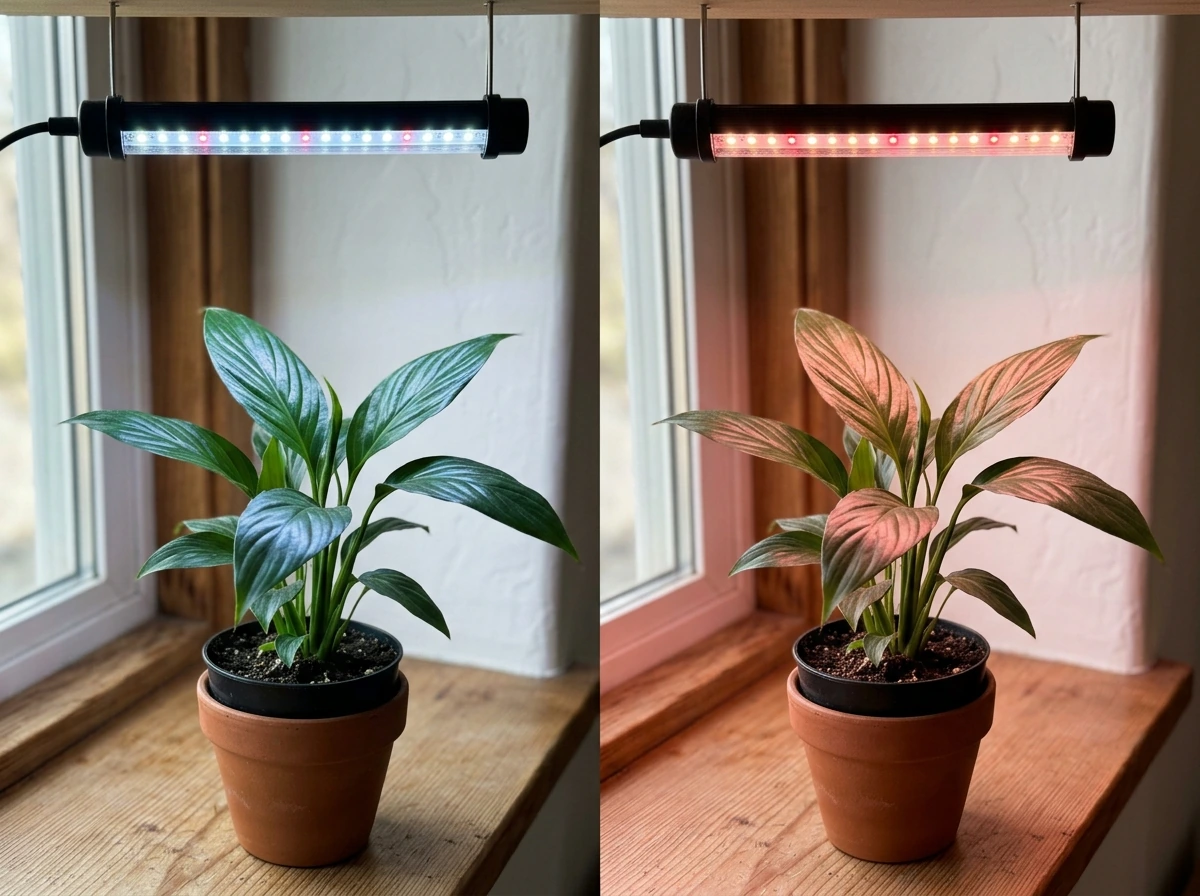
A full-spectrum LED is the go-to. It covers both the blue end of the spectrum (400 to 500 nm), which drives leafy vegetative growth, and the red end (600 to 700 nm), which supports flowering. For peace lilies, balanced full-spectrum light mimics the dappled natural light they're adapted to. You don't need to obsess over specific nanometer values. Just look for a light labeled "full spectrum" or "6000K to 6500K" for vegetative growth, or "3000K to 4000K" if you want to encourage blooming. A light in the 4000K range is a solid middle ground for both.
Distance: this is where most people go wrong
Light intensity drops dramatically as you increase distance from the source. The exact drop depends on your fixture, but as a practical starting point: most small LED grow panels for houseplants deliver a useful PPFD for peace lilies at about 12 to 24 inches from the canopy. Check your light's manufacturer specs for PPFD at different distances if available. If you don't have that data, start at 18 inches and watch the plant for two to three weeks. Move it closer if the plant shows signs of under-lighting (more on that below). Measure at the leaf level if you can, not at the soil.
Setting up your peace lily indoors: timers, placement, and rotation
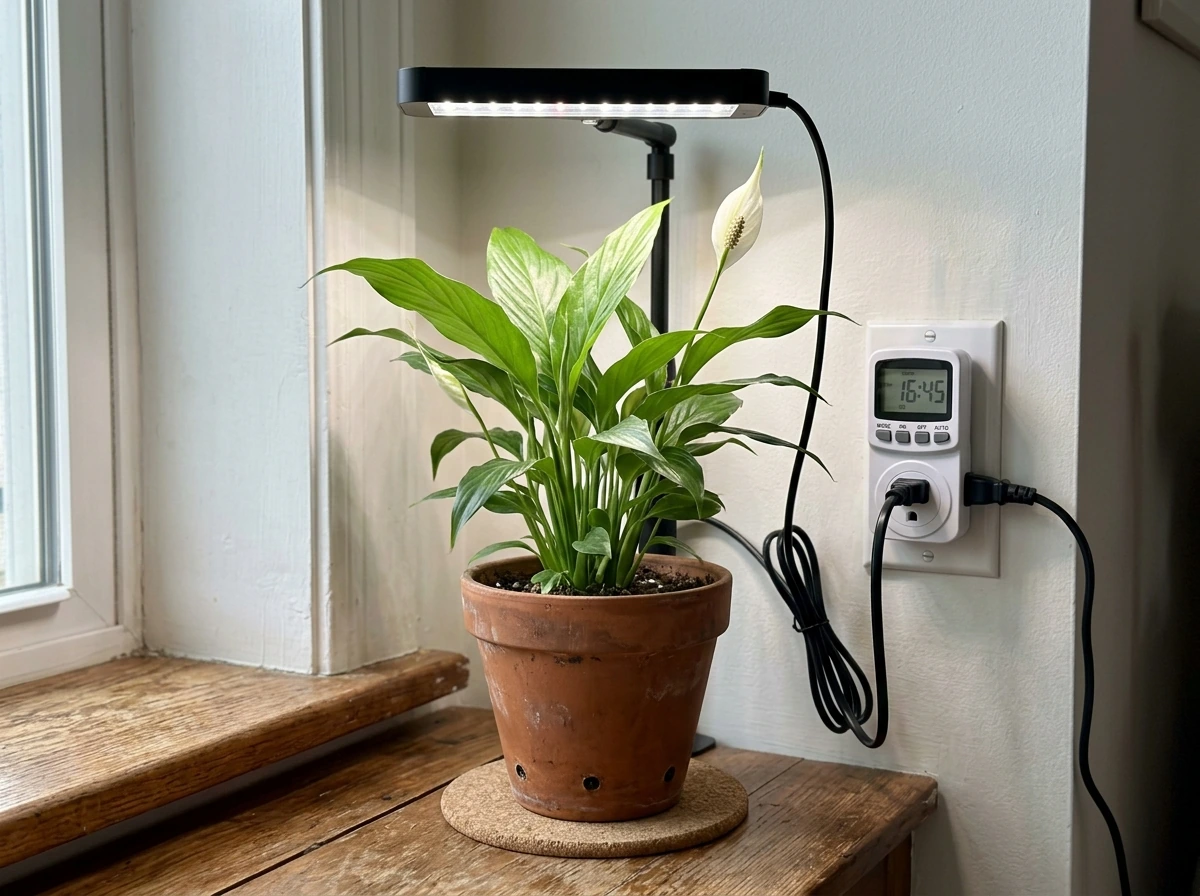
A basic digital outlet timer is one of the best investments you can make for indoor grow light gardening. Set it once and the light runs on a consistent schedule every day without you having to think about it. Consistency is genuinely important here. Erratic light schedules confuse the plant's internal rhythms and can delay or suppress blooming.
For placement, center the light directly above the plant rather than to the side. Peace lilies will lean toward any light source, and side-lighting leads to lopsided growth quickly. If you're using a lamp positioned to the side (common with clip-on or desk grow lights), rotate the pot a quarter turn every one to two weeks so all sides get even exposure.
If you have a spot near a window that gets some natural light but not enough, you can use a grow light as a supplement rather than a primary source. Run it for 6 to 8 hours during the darkest part of the day or during winter months when daylight is short. This hybrid approach is actually very effective and lets you run a lower-intensity fixture without worrying about shortchanging the plant. can peace lily grow in bathroom
- Place light directly overhead, centered above the plant's canopy
- Start at 18 inches between the light and the top leaves
- Set timer for 12 to 16 hours on, depending on your intensity (lower intensity = longer duration)
- Rotate pot a quarter turn every 1 to 2 weeks for even growth
- Reassess after 3 to 4 weeks by checking plant health signs (see below)
- Adjust distance or timer duration if needed, one variable at a time
Signs your peace lily needs more or less light
Your plant will tell you when something is off. You just need to know what to look for. Here are the clearest signals and what they mean under a grow light setup:
Signs of too little light
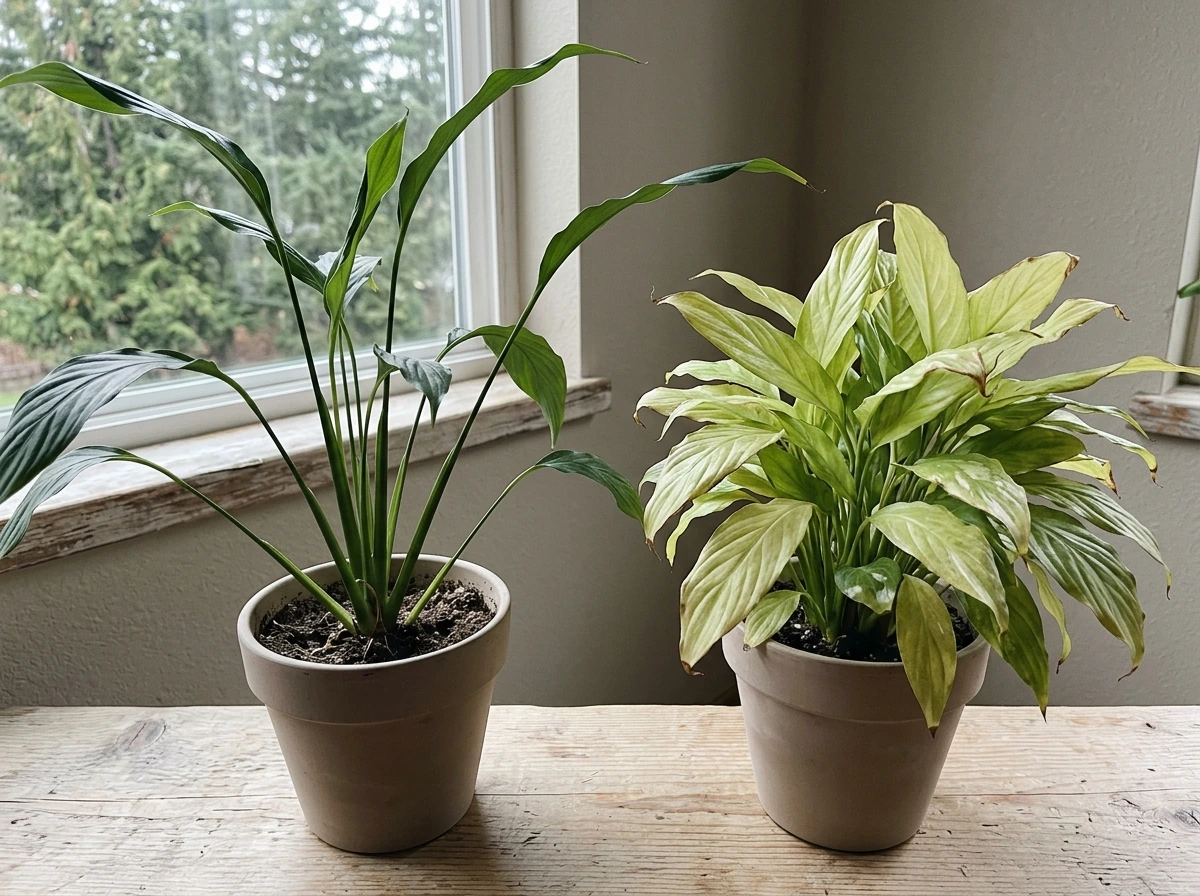
- Leggy, stretchy growth: stems elongate and leaves space out as the plant reaches toward more light
- Small new leaves: new growth comes in noticeably smaller than established leaves
- No new growth at all over 4 to 6 weeks during the growing season
- No blooms despite the plant being otherwise healthy and mature
- Leaves are very dark green and slightly droopy even when watered properly
- Overall slow, sluggish appearance
Signs of too much light
- Leaves look washed out, pale green or yellowish across the whole blade
- Brown, crispy patches or edges (scorch) on the upper leaf surface
- Leaves curl or droop even though soil moisture is fine
- Growth stops or slows despite the plant otherwise looking okay
One important note on brown tips: brown leaf tips on a peace lily aren't automatically a light problem. Fluoride and chlorine in tap water are one of the most common causes, and overwatering can do it too. If only the very tips are browning (not the whole edge or blade), check your watering habits and water source before adjusting your grow light.
Common mistakes and how to fix them
Using a light that's too weak or too far away
This is the most common mistake. A cheap decorative LED bulb or a grow light positioned 3 feet above the plant might be producing less than 10 μmol/m²/s at the canopy. That's survival mode, not growth mode. The fix is simple: move the light closer (start at 18 inches) or upgrade to a fixture that actually specifies its PPFD output. Wattage alone tells you almost nothing useful about what the plant is actually receiving.
Leaving the light on too long (or 24/7)
More hours does not mean better results. Running lights around the clock stresses the plant because it never gets a dark rest period. This can disrupt normal growth cycles and actually suppress flowering. Stick to 12 to 16 hours maximum, and use a timer so you're not relying on memory.
Leggy growth despite the light being on
If your peace lily is stretching and producing long, weak stems, the light is almost certainly too far away or too dim, even if it looks bright to your eye. Human eyes are poor judges of grow-light intensity. Move the light 4 to 6 inches closer and reassess over the next two to three weeks. If you can, a cheap light meter app on your phone can give you a rough foot-candle reading at the canopy to confirm you're in the 100 to 300 fc range.
Dull, pale, or washed-out leaves
If the whole leaf surface looks faded or the plant looks generally washed out, your grow light might actually be too close or too intense. Increase the distance by 4 to 6 inches and see if new leaves come in with better color over the following weeks. Remember that existing damaged leaves won't recover their color, so judge improvement by new growth.
No blooms despite healthy leaves
Flowering requires more light than basic vegetative survival. If your peace lily looks green and healthy but hasn't produced a bloom in a long time, intensity is often the culprit. Research consistently shows that very low light prevents flowering even when vegetative growth continues. Try bumping your light intensity up toward the 50 to 100 μmol/m²/s range (roughly 200 to 400 fc at canopy level) and maintaining a consistent 12 to 14 hour photoperiod. Also make sure the plant is mature (typically at least a year old) and not root-bound, since those factors affect blooming independently of light.
Inconsistent schedule
Manually switching lights on and off inevitably leads to inconsistency. Peace lilies are sensitive to sudden changes in their light environment. A $10 to $15 digital outlet timer solves this completely. is miracle grow good for peace lily Set it and forget it.
Quick checklist: is a grow light setup right for you?
If you're still deciding whether to go the grow light route, or you want to make sure you've covered all the basics before you start, run through this checklist:
- Do you have a spot with less than 50 fc of natural light? (A north-facing room, a dark hallway, a windowless bathroom) If yes, a grow light is the right call.
- Have you chosen a full-spectrum LED fixture that lists its PPFD output or can be measured at 18 inches? If not, prioritize that before buying anything else.
- Do you have a digital timer set to run the light 12 to 16 hours daily? This is non-negotiable for a consistent schedule.
- Is the light positioned directly above the plant, centered over the canopy, at 12 to 24 inches distance?
- Are you rotating the pot a quarter turn every 1 to 2 weeks?
- Have you given the setup at least 3 to 4 weeks before making adjustments? Peace lilies are slow to show responses to light changes.
- Are you watering with filtered or room-temperature tap water that has sat out overnight? This rules out water quality as a confounding factor when troubleshooting.
If you checked off most of those boxes, you're set up for success. Your next step is simple: get the light in place, set the timer for 14 hours on and 10 hours off as a starting point, and check back on the plant after three to four weeks. Look for new leaf growth as your primary sign that the setup is working. From there, you can fine-tune distance or duration based on what the plant is telling you.
One last thing: grow lights solve the light problem, but they don't replace good overall care. Peace lilies in low-light or grow-light setups still need appropriately moist (but not waterlogged) soil, humidity above 40 percent if possible, and temperatures above 60°F. If you're also wondering whether your peace lily might do better outdoors, specifically whether can peace lily grow outside, in your climate, or how it handles naturally dim rooms without any supplemental light, those are questions worth exploring separately since the answers vary a lot depending on where you live and what conditions you can provide. can peace lilies grow outside uk
FAQ
How far should the grow light be from the peace lily leaves?
Start around 18 inches from the canopy. If you see stretching or weak, thin stems, move it closer 4 to 6 inches, then reassess after 2 to 3 weeks. If new leaves look pale or washed out, increase the distance by 4 to 6 inches. Try to judge based on new growth, not older leaves.
Can I use a regular LED bulb instead of a grow light?
You can, but many “decorative” or high-wattage bulbs do not deliver enough useful light energy at leaf level. The key is output at the canopy (PPFD) rather than wattage. If the bulb is placed far above the plant, it often lands in survival mode, even if it looks bright in the room.
Should I run grow lights continuously for faster growth?
No. Peace lilies need a daily dark period. A practical range is 12 to 16 hours on, then 8 to 12 hours off. Avoid 24/7 lighting because it can disrupt normal rhythms and reduce flowering.
What photoperiod should I use if my light is the only light source?
Begin with 12 hours on and 12 hours off. If your PPFD is on the lower end, you can extend toward 14 to 16 hours to increase total daily light. If you are achieving stronger intensity, 12 hours is usually enough.
Why is my peace lily growing but not blooming under grow lights?
Blooming usually needs more light than basic survival, plus the plant often must be mature (often at least a year old). If it stays green with no flowers, try raising intensity toward the 50 to 100 μmol/m²/s range while keeping a consistent 12 to 14 hour photoperiod. Also check that it is not root-bound and that it is receiving consistent care.
My peace lily tips are turning brown, is it definitely a light problem?
Not necessarily. Brown tips are frequently caused by water chemistry issues like fluoride or chlorine in tap water, or by inconsistent watering. If only the very tips brown (not the entire edge or whole blade), adjust your watering and consider using filtered or low-mineral water before changing the light setup.
How do I know if my grow light is too dim or too intense without a PPFD meter?
Watch growth patterns. Too dim often causes stretching and weak, elongated stems. Too intense or too close can fade leaf color and make new leaves look washed out. In either case, adjust distance in 4 to 6 inch steps and evaluate new growth over 2 to 3 weeks.
Do I need full spectrum, or will a single-color LED work?
A balanced full-spectrum LED is the simplest option because it covers the range that supports both leafy growth and flowering. Single-color setups can work for some plants, but you may need more trial-and-error to get blooming. If you want an easy decision aid, choose a light marketed as full spectrum or in the 4000K to 6500K range for general growth.
Should I measure brightness at the soil or at the leaves?
Measure or evaluate at leaf level (the canopy). Light falls off quickly with distance, and reading it at the soil often overstates how much the leaves actually receive. If you use an app for foot-candles, take it at the height where the top leaves are.
Can I use grow lights in a room that still gets some window light?
Yes, and it often works better than going fully artificial. Use the grow light as a supplement during the darkest hours or in winter, for example 6 to 8 hours. This lets you use a lower-intensity fixture while still keeping the daily light more consistent.
How can I avoid lopsided growth if my light comes from one side?
Center-lighting is best. If your lamp is on the side, rotate the pot a quarter turn every 1 to 2 weeks so all sides get similar exposure. This reduces leaning and helps the canopy stay even.
Will a grow light replace humidity and watering needs for peace lilies?
No. Light can fix the light problem, but it does not replace moist, well-draining soil, humidity, and temperature targets. Even with good lighting, peace lilies still tend to struggle if kept too wet, too dry, too cold (below about 60°F), or in very dry indoor air.
Next Articles
Can Peace Lily Grow Without Sunlight? Light Guide and Fixes
Learn if peace lilies can grow with no sunlight, how much indirect light they need, and quick fixes for poor light.
Can Peace Lilies Grow Outside in the UK? Practical Guide
See if peace lilies can grow outside in the UK, with placement, watering, summer care, and winter overwintering tips.
Can Peace Lily Grow Outside? Outdoor Care for Success
Learn if peace lilies can grow outside and get outdoor care tips: light, cold limits, soil, watering, and NZ guidance.